
Bo and Rebecca mark out the veggie beds for the coming season, planning to use the BIO-INTENSIVE METHOD
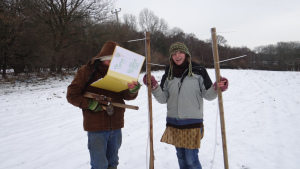
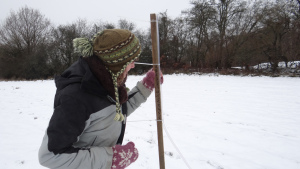
With hopes of setting up a Community Supported Agriculture scheme this year at The Crossing, we set about marking out the area for growing vegetables. Bracing the icy winds and snow, we managed to successfully peg out two of the top contour lines at The Crossing, despite racing against the freeze of the water in the bunyip! No, not the Australian mythical creature that dwells in water, but a long clear pipe which we tie-wrapped to two stakes marked to compare the water level. We tipped water into the pipe (warm water so it didn’t freeze instantly) and made sure that the water levels were matching in the two ends when we stood together on level ground. As I moved along what I imagined was the contour, Bo watched the water in the his end of the pipe and called to me to move up or down the slope. When the water in both ends was level again, we stuck in a stake and moved along the contour. The process involved a lot of “UP A BIT! DOWN A BIT!” “NO BACK A BIT!” but nevertheless, we were amazed to discover how accurate this simple technique is!
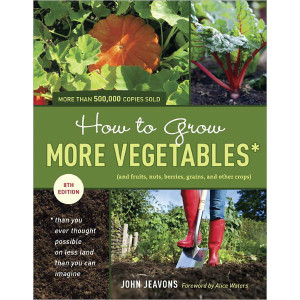
Once we had marked two contour lines, we could then see the strip of land we were ready to work on. Bo and I are trying out the BIO-INTENSIVE GARDENING technique after I was bowled over by a 2-day taster course in Australia and then devouring John Jeavon’s fantastic book ‘HOW TO GROW MORE VEGETABLES THAN YOU EVER THOUGHT POSSIBLE ON LESS LAND THAN YOU CAN IMAGINE’. Emma and Stuart have kindly given us the go-ahead to try this out at The Crossing, and we couldn’t be luckier! The patch is slightly sloping and south-west facing.

We have planned to prepare 48 beds of 1.2m x 8m and the picture on the left shows Bo (on a much warmer day!) marking them out with pegs and string.
The BIO-INTENSIVE GARDENING technique is one that has been developed in the US by John Jeavons and the awesome Ecology Action team. Bio-intensive proposes a technique of sustainable ‘mini-farming’; small scale, diverse agriculture which shows that pretty much anyone can feed themselves in a small area! The main principles are building soil fertility, growing crops for compost, closely spaced planting, creating a closed system of nutrient recycling and producing lovely mineral-rich fresh food at the end of the day.
The things that appealed most to Bo and I about this technique was that it is backed up by years of in the ground research in several locations by the same group and it is the only gardening technique which takes into consideration where the compost needed to build soil fertility comes from. The bio-intensive method suggests allowing for 60% of your crops to be high-carbon crops which will provide plenty of material to build your compost with. It is not feasible for most small-scale gardeners or producers to import huge amount of straw or manure for compost and mulch, so it makes perfect sense to grow it ourselves. Another good point is that while we may be improving our soil by adding imported straw or manure, these vital minerals are being removed from some other land, depleting the soil there. To truly grow you soil, we must consider growing our own materials to create fantastic compost for the following year. Having said all that, the first year is a tricky one, and although Bo and I have been scurrying around gathering precious green material and carbon for our compost it will not be ready in time to prepare our beds so for this first season we will be relying on decomposed manure from our generous neighbours and a batch of spoilt straw bales obtained locally. We are very fortunate to have these resources to use to help us build up the soil quality.
Rebecca


