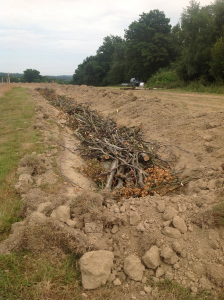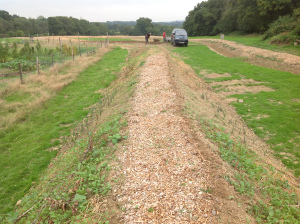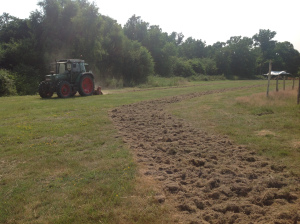
Over the summer months we have been working with Jay Abrahams of Biologic Design to put in water conservation features such as swales and ponds to improve our water retention on site. We want to preserve every drop that falls here and also improve drainage where needed.
The aim is to create a flood resistant and drought tolerant landscape which will maximise diversity and therefore resilience, creating productive growing zones what ever the weather. Jay has dubbed The Crossing, the ‘first whole site water-reticulation system in the UK’.
Swales are akin to the ‘ridge and furrow’ of medieval farming, and retain any surface run-off in a long ditch and bank that runs along contour. The bank can be planted with fruit bushes and trees.
Swales create optimal growing conditions and should fill with water when rainfall is high, allowing water to slowly soak away. Two ponds feed into the swales to irrigate in times of drought.
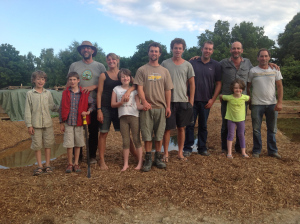
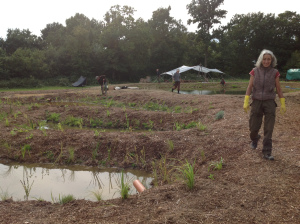
A WET system will treat grey water from the field kitchen and veg prep station. Wetland Ecosystem Treatment (WET) systems function by creating a community of plant roots and micro-organisms in a series of ponds which act as a biological purification system.
Microbiologist Jay Abrahams has over 20 years experience including waste water treatment for Westons Cider. Biologic Design is currently in consultation with a branch of the Environment Agency. We are extremely priveleged to be working with this fantastic team.
Inspired by maverick Austrian farmer Sepp Holzer we have also created a 20m long ‘Hugel’ bed over 1.5 m high. ‘Hugelkultur’ translated in German as literally ‘mound cultivation’ The wood buried in the mound acts as a sponge, soaking up water, releasing moisture when needed. It houses and feeds the micro-organisms that help create amazing soil. Warmth from the decomposing wood warms the roots in winter.